Table of Contents
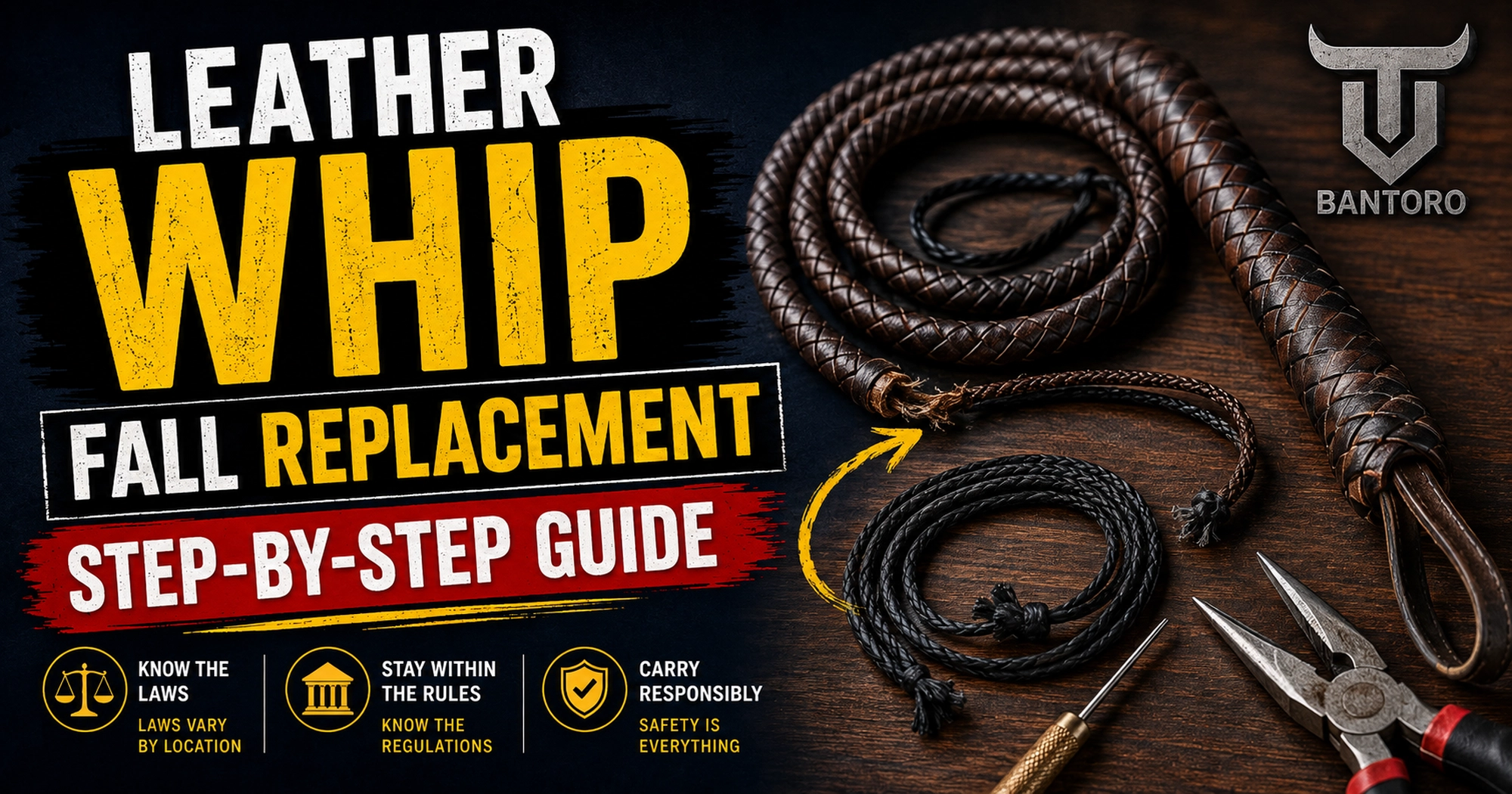
ToggleA leather whip is made from several working sections, and not every sign of wear means the complete whip has reached the end of its useful life. One component that is designed to be replaceable is the fall—the leather section between the braided body of the whip and its cracker or popper.
Because the fall sits close to the working end of the whip, it can gradually become worn, dry, thin, split, or otherwise damaged through use and environmental exposure. When the damage is limited to this component, a leather whip fall replacement may be a much more practical solution than replacing the entire whip.
In this guide, we’ll explain how to recognize a worn fall, what to consider when choosing a replacement, the general replacement process, the difference between the fall and cracker, and how regular care can help keep your leather whip in good condition.
Bantoro produces handcrafted leather whips and provides educational resources to help owners better understand their equipment, its construction, and its maintenance.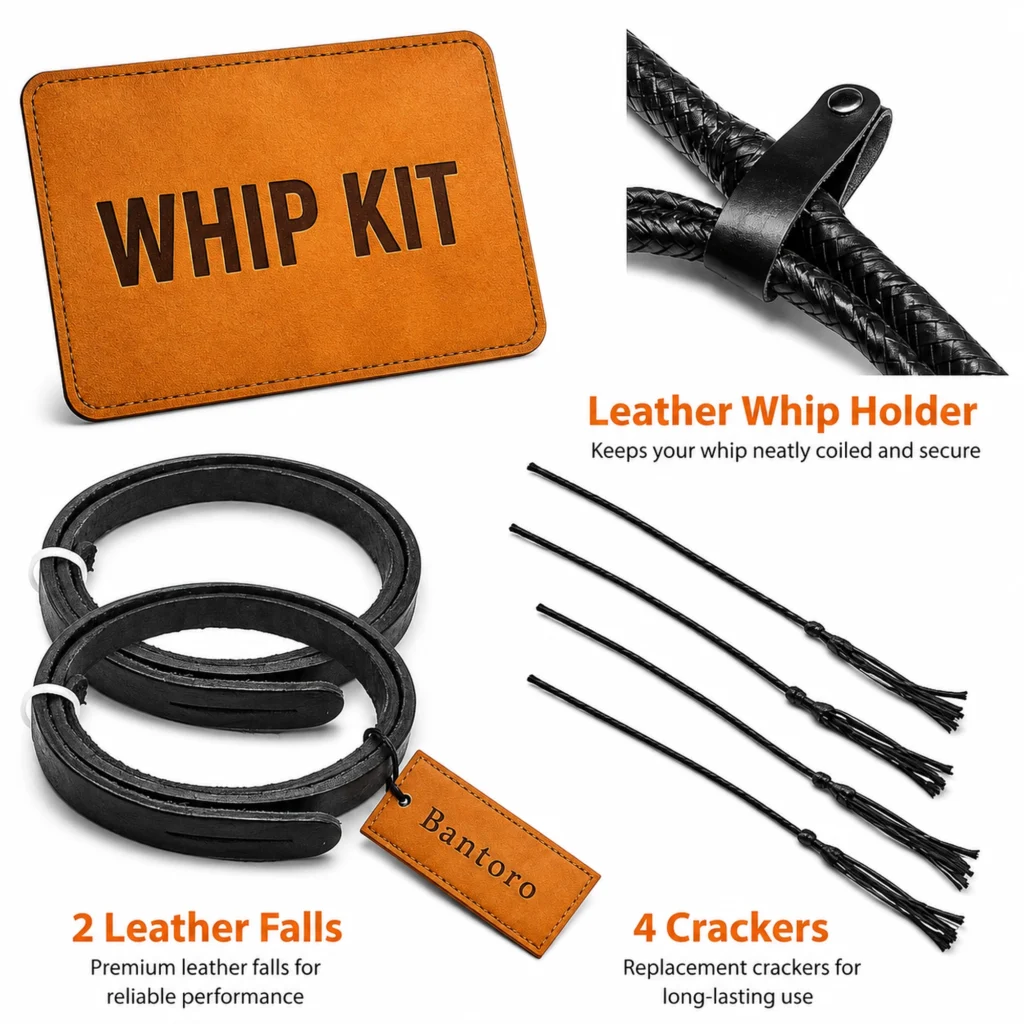
What Is a Leather Whip Fall?
The fall is the relatively narrow leather section located toward the end of a traditional leather whip.
A simplified whip construction looks like this:
Handle → Braided Thong → Fall → Cracker/Popper
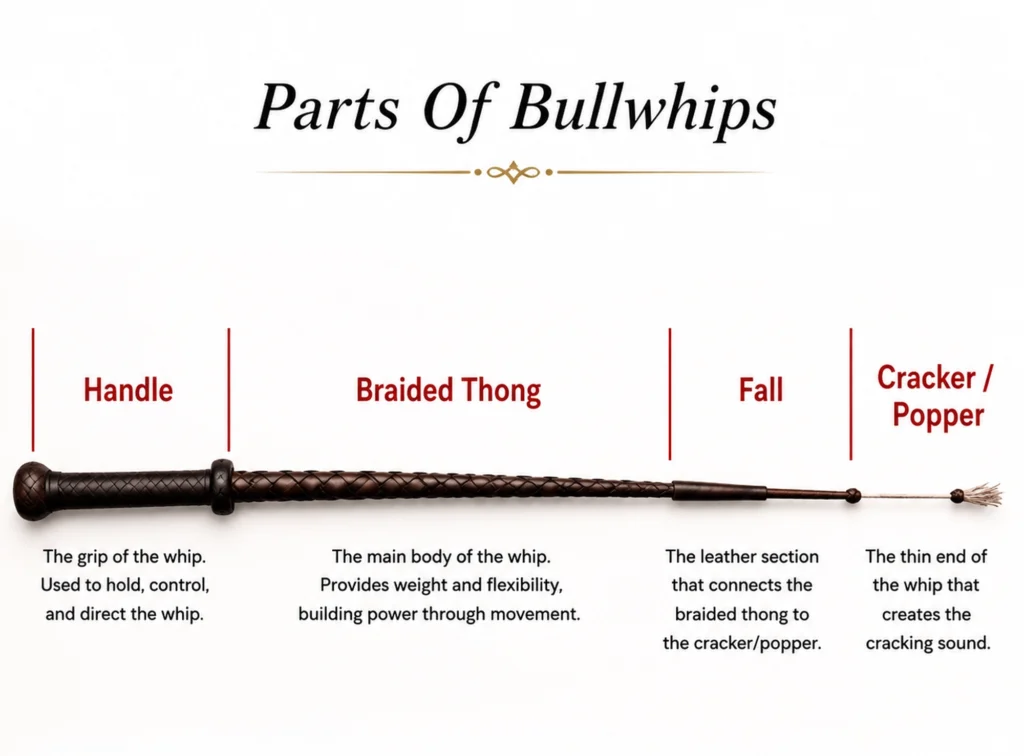
The braided thong forms the main flexible body of the whip. At its end, the fall is attached to the thong, commonly through an attachment known as a fall hitch. The cracker or popper is then fitted at the terminal end of the fall.
This distinction is important because the fall and cracker are two different components.
The fall is made from leather and forms the transition between the braided thong and the much lighter terminal component. The cracker or popper is the thin cord fitted at the very end.
One advantage of this construction is serviceability. If the fall becomes damaged while the rest of the whip remains in suitable condition, the fall can generally be replaced separately rather than treating the entire whip as a single non-serviceable unit.
When Does a Leather Whip Fall Need to Be Replaced?
There is no universal number of sessions, months, or years after which every leather whip fall should be replaced.
Wear depends on the whip’s construction, how frequently it is used, the surfaces and conditions in which it is handled, how it is stored, and how the leather is maintained.
Instead of relying on a fixed replacement schedule, inspect the actual condition of the fall.
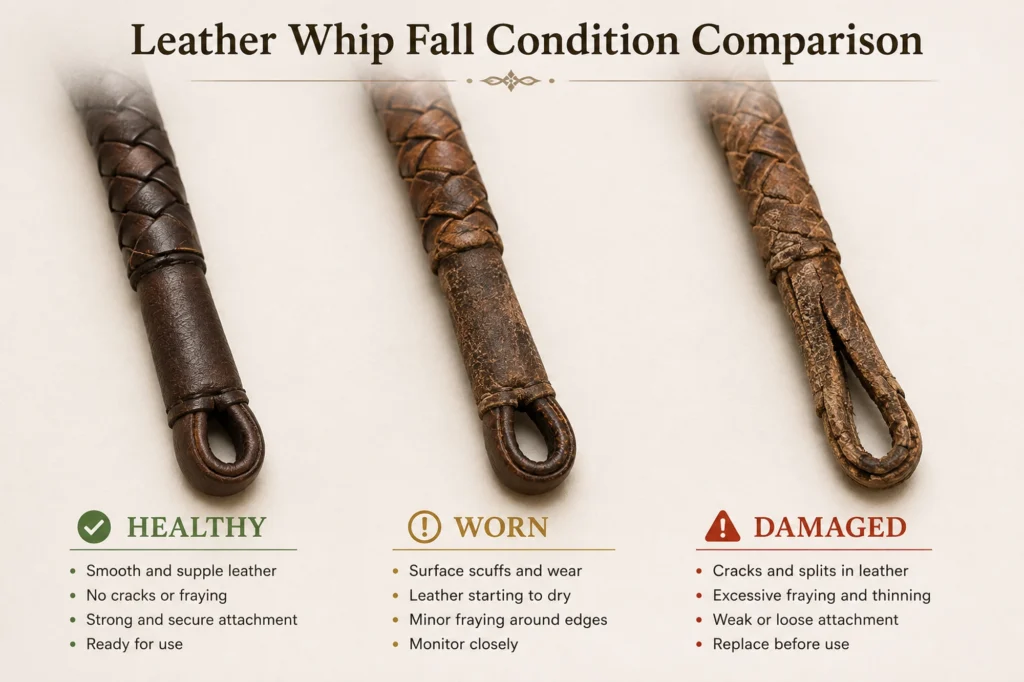
Common warning signs include:
- Significant fraying or rough deterioration
- Cracks developing in the leather
- Splitting along the fall
- Areas that have become excessively thin
- Severe dryness or brittleness
- Damage close to the attachment point
- A loose or compromised connection to the thong
- Significant wear where the cracker attaches
Minor surface changes do not automatically mean replacement is required. The more important question is whether the leather and its attachment remain sound.
If you are uncertain, stop using the whip until you have inspected the fall and the surrounding attachment area properly.
What You Need for Leather Whip Fall Replacement
A straightforward whip fall replacement does not normally require a large collection of tools.
You will generally need:
- A compatible replacement leather fall
- Your existing whip
- The existing cracker/popper or a suitable replacement
- A clean, well-lit work surface
- A ruler or measuring tape
- A suitable cutting tool only if trimming is genuinely required
The most important item is not a specialized tool—it is a compatible fall.
Before fitting anything, compare the replacement with the original fall. Length, width, thickness, leather quality, and the attachment end all influence whether the replacement is appropriate for the existing whip.
When repairing a whip that previously performed well, using the original fall as your reference is usually the simplest starting point.
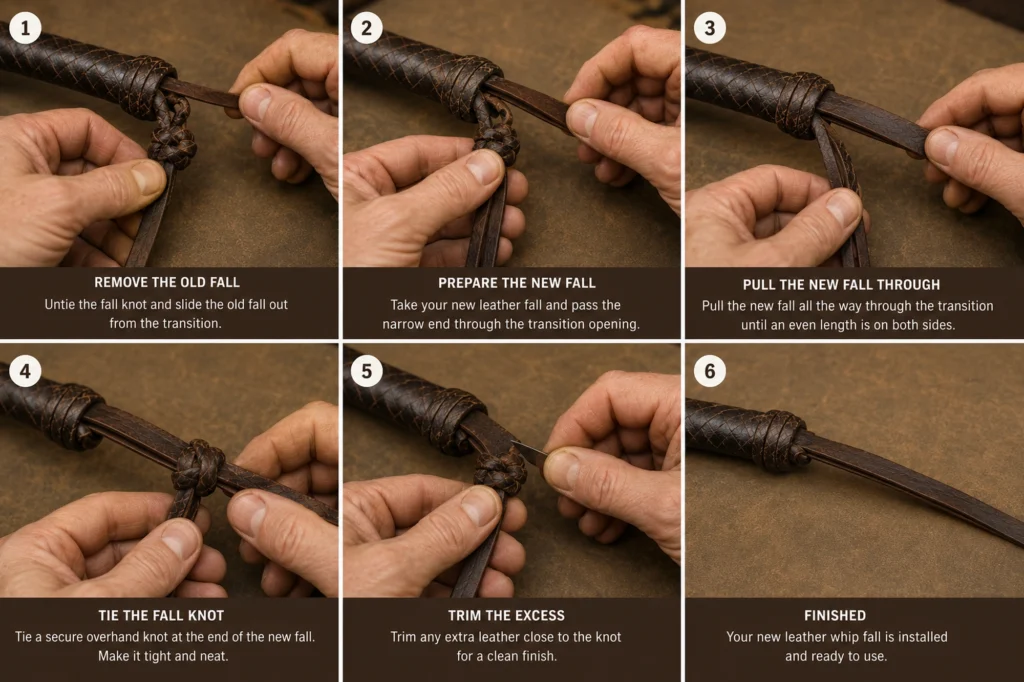
How to Replace a Leather Whip Fall
The exact attachment can vary with whip construction, so inspect your particular whip before beginning. If its attachment differs from what you recognize or the braided end itself appears damaged, seek guidance appropriate to that whip rather than forcing the repair.
Step 1 — Inspect the Existing Fall
Before removing anything, examine the old fall carefully.
Start at the point where the braided thong ends and the fall begins. Look for looseness, damaged braid work, cuts, broken leather, unusual distortion, or deterioration immediately around the attachment.
Then inspect the full length of the fall.
Check for cracking, splitting, excessive thinning, severe dryness, and damage around the point where the cracker or popper is attached.
The purpose of this inspection is to determine whether the repair is actually limited to the fall.
If the fall is worn but the braided thong and its attachment area remain sound, replacement may be relatively straightforward. If the braided structure itself is damaged, simply fitting another fall may not address the underlying problem.
Before removal, it can also be useful to note the approximate length and width of the existing fall and observe how it is currently attached.
Step 2 — Remove the Old Fall
Removing the damaged fall should be done carefully. The objective is to release the old component without unnecessarily cutting, pulling, or damaging the braided thong.
First identify how the fall is secured at the end of your whip.
Work slowly and loosen the existing attachment rather than immediately reaching for a cutting tool. Pay particular attention to the leather and braid immediately above the attachment.
Avoid pulling aggressively against the braided thong. A fall that has been fitted for a long time may have settled tightly into its attachment.
Once released, keep the old fall rather than throwing it away immediately. It provides a useful physical reference when checking the dimensions and general configuration of the replacement.
If removal exposes previously hidden damage in the braided end, stop and reassess before fitting the new component.
Step 3 — Prepare the Replacement Fall
Place the old and new falls next to one another.
Compare their:
- Length
- Width
- Thickness
- Leather quality
- Attachment ends
- Overall compatibility with the whip
For an existing whip, closely matching the original component is generally the simplest approach because it gives you a known reference rather than choosing dimensions arbitrarily.
Do not assume that any strip of leather is automatically suitable simply because it looks similar.
The leather should be in good condition, appropriately formed for its intended use, and free from obvious cracks, weak areas, or severe dryness before installation.
If the old fall has stretched, broken, or lost material, remember that its present dimensions may not perfectly represent its original condition. Use judgment rather than blindly copying obviously damaged sections.
Step 4 — Attach the New Fall
Once you are satisfied that the replacement is appropriate, it can be secured to the end of the braided thong.
On traditional constructions, this connection is commonly associated with the fall hitch.
Because the precise configuration can depend on how the whip was made, identify and follow the attachment method appropriate to your particular whip. The objective is to create a secure transition without unnecessarily damaging, crushing, or distorting the braided end.
The replacement fall should emerge cleanly from the end of the thong and should not appear twisted or incorrectly seated.
If you cannot confidently identify the correct attachment configuration for your whip, refer to a verified demonstration or obtain advice from an experienced whip maker before proceeding.
This is preferable to improvising a knot that merely appears secure.
Step 5 — Attach the Cracker or Popper
The cracker—also commonly called a popper—is the thin terminal component at the very end of the whip.
It should not be confused with the leather fall.
The sequence remains:
Braided Thong → Leather Fall → Cracker/Popper
Once the replacement fall is properly installed, the cracker or popper can be fitted to its terminal end using the appropriate connection for the components being used.
Inspect the cracker before reusing it. Replacing a damaged fall while reinstalling a severely worn terminal component defeats the purpose of carefully servicing the working end of the whip.
After attachment, confirm that the cracker is properly secured to the fall.
Step 6 — Inspect the Finished Replacement
Do not consider the job complete the moment the new fall is attached.
Inspect the repair from the braided thong through to the cracker.
Check that:
- The fall is securely attached
- The attachment sits correctly and appears properly aligned
- The replacement leather is in sound condition
- Installation has not damaged the surrounding braid
- There is no obvious unnecessary stress at the connection
- The cracker/popper is securely connected
A careful final inspection can reveal an attachment problem before the whip is returned to use.
Watch the Bantoro Leather Whip Fall Replacement Video
Written instructions are useful for understanding the components and preparation, but seeing the process can make the relationship between the thong, fall, and cracker easier to understand.
Watch Bantoro’s leather whip fall replacement video alongside this guide as a visual reference.
How to Maintain a Leather Whip Fall
Good leather whip maintenance begins with inspection rather than excessive treatment.
After use, remove ordinary surface dirt appropriately and make sure the whip is stored in conditions that do not leave the leather persistently wet or exposed to damaging environmental conditions.
When leather conditioning is appropriate for your particular whip, use a suitable leather-care product and apply it conservatively. More conditioner is not automatically better. Excessive oiling or conditioning can be undesirable, so follow the care recommendations appropriate to the leather and construction.
Storage matters as well. Keep the whip in a suitable environment and inspect the fall periodically for cracking, thinning, splitting, attachment wear, and deterioration around the cracker connection.
Consumable or replaceable components should be serviced when their actual condition requires it rather than being ignored until failure.
For broader maintenance information, consult Bantoro’s Leather Bullwhip Care Guide.
Leather Whip Fall vs. Cracker/Popper
These terms are sometimes confused by people who are new to whip construction.
| Component | What It Is | Main Purpose |
|---|---|---|
| Braided Thong | Main braided body | Primary structure |
| Fall | Leather section at the end | Connects thong to cracker |
| Cracker/Popper | Thin terminal cord | End component |
The easiest way to remember the difference is to look at their order.
The braided thong leads into the leather fall, and the cracker/popper sits at the terminal end of the fall.
If the thin cracker is worn but the leather fall remains sound, the cracker may be the component requiring attention. If the leather section itself is cracked, split, badly thinned, or damaged around its attachment, then the fall should be inspected for replacement.
Frequently Asked Questions
1. What is a leather whip fall?
A leather whip fall is the leather section positioned between the main braided thong and the cracker or popper at the working end of the whip.
2. How do I know when my whip fall needs replacing?
Look for significant cracking, splitting, excessive thinning, severe dryness, attachment damage, or deterioration around the cracker connection. Assess the actual condition rather than relying on a fixed replacement schedule.
3. Can I replace a leather whip fall myself?
A fall can be a replaceable component, but you should understand your whip’s construction and correct attachment method before attempting the repair. If the braided thong is damaged or the attachment is unclear, seek appropriate specialist guidance.
4. Can I replace the fall without replacing the entire whip?
Generally, yes. One purpose of having a replaceable fall is that a worn fall can be serviced independently when the rest of the whip remains in suitable condition.
5. What is the difference between a whip fall and a cracker?
The fall is the leather section attached to the braided thong. The cracker or popper is the thin terminal cord attached at the end of the fall.
Final Thoughts
A worn fall does not automatically mean that an otherwise serviceable leather whip must be replaced.
A careful leather whip fall replacement can address wear at this replaceable component while retaining the rest of the whip. The key is to inspect the surrounding construction first, choose a compatible replacement, secure it using the attachment appropriate to the whip, and check the complete repair before returning it to use.
Regular inspection also makes it easier to identify wear while it is still localized to replaceable components.
For more information about traditional leather whips, care resources, and related equipment, explore Bantoro’s handcrafted leather whips and accessories.